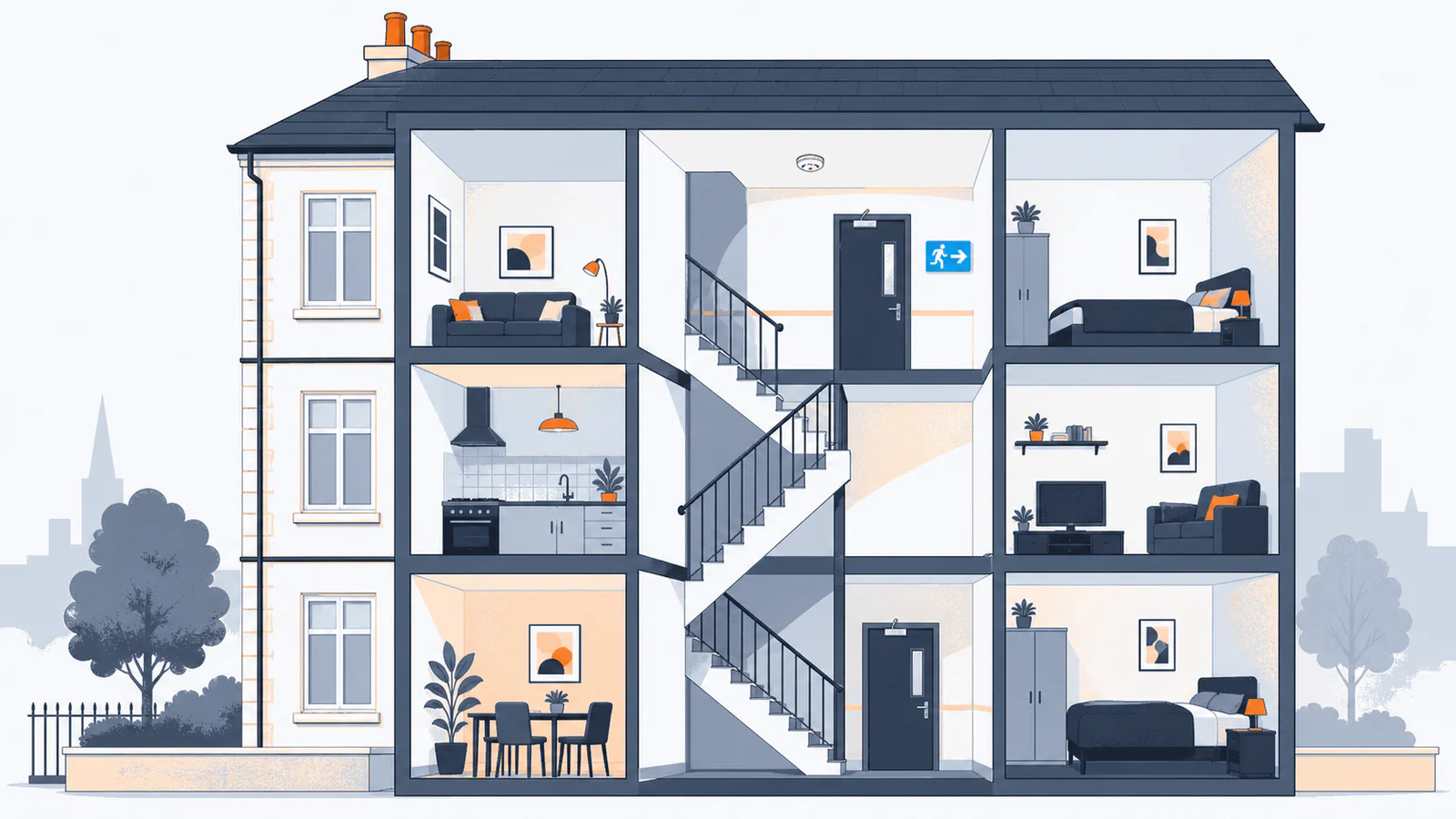
The fire safety rules for blocks of flats and other multi-occupied residential buildings have changed repeatedly since the Grenfell Tower fire, and 2026 has added another layer. If you are a freeholder, a residents' management company, or a managing agent, it can be hard to keep track of what you are actually required to do. This guide sets out the current stack of duties in plain English. It is general information rather than legal advice, and final wording should always be checked against the legislation itself.
Who this applies to
These duties attach to the common parts of buildings that contain two or more domestic premises: purpose-built blocks of flats and houses converted into flats. The person who must comply is the responsible person for those communal areas, which is typically the freeholder, the residents' management company, or the managing agent acting on their behalf. Individual leaseholders are generally not the responsible person for the building, though they have a clear interest in it being done properly.
The duties, in the order they arrived
Regulatory Reform (Fire Safety) Order 2005
This is the foundation. The responsible person must carry out and maintain a suitable and sufficient fire risk assessment of the communal parts, act on what it finds, and keep it up to date. Everything below sits on top of this duty.
Fire Safety Act 2021
This Act clarified the scope of the Fire Safety Order for multi-occupied residential buildings. It confirmed that the building's structure, its external walls (including cladding, balconies and windows) and the flat entrance doors are within the scope of the fire risk assessment. In short, the assessment is not just about the hallways. External wall safety can also trigger a separate request when a flat is sold, the EWS1 form, which we cover in our guide on EWS1 form vs fire risk assessment.
Fire Safety (England) Regulations 2022
In force since 23 January 2023, these regulations placed specific, practical duties on responsible persons of multi-occupied residential buildings. The exact duties step up with the height of the building. Additional duties apply to buildings above 11 metres, such as regular checks of fire doors in the communal areas, and further duties apply to high-rise buildings above 18 metres, such as sharing building information and plans with the fire and rescue service and installing a secure information box. There are also general duties, regardless of height, around giving residents fire safety instructions.
Building Safety Act 2022, Section 156
Effective 1 October 2023, Section 156 amended the Fire Safety Order. It removed the previous rule that only businesses with five or more employees had to record their assessment in full, so now every responsible person must record the fire risk assessment in writing. It also requires recording who carried out or reviewed the assessment, and it raised the maximum fines for serious breaches to an unlimited amount.
Fire Safety (Residential Evacuation Plans) (England) Regulations 2025
This is the change that is new for 2026. These regulations came into force on 6 April 2026 and introduce residential personal emergency evacuation plan duties for higher-risk residential buildings, aimed at residents who may not be able to evacuate without assistance. For responsible persons of qualifying buildings, this means assessing and planning for the evacuation needs of those residents, on top of the existing duties above. Much of the fire safety content written before 2026 predates this requirement, so it is worth making sure any guidance you rely on is current.
What this means in practice in 2026
For a responsible person looking after a block of flats this year, the practical checklist is:
- Have a current, suitable and sufficient fire risk assessment of the communal parts, recorded in full and reviewed regularly.
- Make sure it covers the structure, external walls and flat entrance doors, not just the internal common areas.
- Carry out the height-related duties that apply to your building, such as fire door checks above 11 metres and information sharing above 18 metres.
- For higher-risk buildings, address the new residential evacuation planning duties that took effect in April 2026.
- Act on the assessment's action plan and keep the certificates that prove the work was done.
If a flat in the building is being sold or remortgaged, the buyer's solicitor or lender will often ask to see the current assessment, which is covered in our guide on fire risk assessments when selling a flat. Landlords with flats in the block have their own overlapping duties, set out in our landlord fire risk assessment guide.
How J&L Security can help
Meeting these duties means having the assessment done and then acting on it. J&L Security arranges the assessment through a fire risk assessor we work with who holds AIFSM, TMIFPO and NEBOSH, and carries out the resulting remedial works directly: fire alarm installation and maintenance to BS 5839 (we are BAFE-accredited for the installation and maintenance of fire alarms), emergency lighting, electrical testing, and fire door works. For a freeholder or managing agent, dealing with one company from assessment to certified, completed work is the simplest way to stay on top of a moving set of rules.
We cover Essex and Greater London. See our fire risk assessments page and fire alarms page, or call 0204 538 5925 or 0208 220 4770. You can also request a call back.